Sunday, November 25, 2018

All Original

The toughest gig in my opinion is the all original:  no cover songs.  Why?

For the longest time in my life, opportunities to play all original were rare.  The room owners would fight us on this topic.  They wanted commercial songs.  They did not believe local songwriters could compete with Nashville or Muscle Shoals writers.   There is still some of that going on.  Ours is a STEM-city.  White collar.  Music is blue collar work.

There was no vision and not much support.  Some writers would make the trek between Huntsville and those Real Music Cities because there were more live gigs here.   But even then, they played a mix of covers and originals with emphasis on the covers.   We became clones of famous acts which is what the audience wanted.

Then when the web took the money out of songs, the performance rights organizations (PROs) such as ASCAP/BMI/SESAC went on a head hunting rampage across the smaller rooms that support small acts such as soloists and duos.   The fees to pay them were/are harder on the small rooms and as a result, the owners of rooms where budding songwriters performed stopped having live music or closed their doors.  It was a tactical nuke on the innocents.  No one deserved that particularly the kids just starting out as performers.

OR... the room owner made a rule that acts could only play all original.   As long as the songs are not registered with the PROs, the muscle men cannot force the rooms to pay fees.   They try but the room owner can tell them to go fuck themselves.    Some PRO writers cannot play these rooms or if they do, they are asked to send a list of what they played to the PRO with which they are affiliated.  Then the muscle men bugger the room.  The room pays the fees or gets sued.   It's an ugly business but that is a different topic.   It is all legal.   On the other hand....

The unforeseen consequences were some professionals were kicked out of the spotlights and small rooms where they might have ruled instead opened up to a new generation of very young songwriters with attitudes.   Pluses and minuses because where there were opportunities, quality went straight down the tubes.  No free lunch.

For a short time, there was freedom. Gigs that even if not well paid were accessible.  Now we have boutique real estate interests and fly by night talent and artist development types sucking up the oxygen.  Oh well.  The kids are starting to see the hustle and where it all goes from here, one can't say.  The politics of greed are the politics of the music business.  Sad but so.

Before moving on, watch this video.  You need to know the reality of making a living in the music business.  It is not the royal road to riches it once was.  Sad but so.


Those are the facts.   Being able to work live as a singer songwriter is more important than ever.  So this is to say there are now more rooms for all original.  Your time has come. :)

If you can.   And that is not that easy.

Most singer-songwriters don't start with a full evening of songs they have written and can perform.   A night with other writers playing on average, three songs, or perhaps a twenty minute set are common. Three hours, or on average three forty-five minute sets is a lot of songs.   A lot.  Roughly 45 songs.   If that doesn't seem like a lot, try running for forty-five minutes while speaking on your phone and knitting.  Do that three times in three hours.

That's the physical challenge and you have to meet that no matter what you play.   I say this simply because too many people think it is easy.  It is not.   You leave zoinked and a little empty most nights.

Then there are the songs.  Do you have 45 original songs?  Or are you a Grateful Dead act doing one song for forty five minutes?   Good songs?  Songs that are cohesive, can hold your attention?  Can hold an audience's attention?   Can you play them every night and still do that?  Without boring your audience or yourself?   And some songs are not appropriate for some rooms and some audiences.  A family room is not necessarily the best place to sing about your long night out drinking and banging your sig other.  Randy may not be handy.

So be honest:  most don't and those that can won't because they aren't confident about their songs.   The singer-songwriter night is usually as I said, a night done with other performers, perhaps together, perhaps as separate acts swapping out.   That is a good deal.  You get to see what others are doing, swap some licks and share an audience, perhaps some social media cred, so networking or schwoozing as the old timers would say.   You may be the host and emcee.  You may be on the bill.
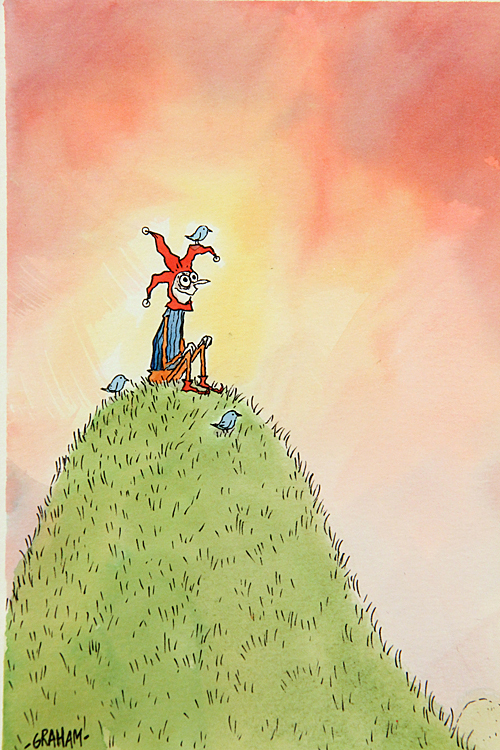
Or you may be the fool on the hill.   You want to play an evening of your songs.  You do this because you can, you want to and you like the view.   And the challenge.  Good.   Too many claim to be songwriters but don't understand that singing and performing songs well are part of the craft.

Most of us who do play an evening as a soloist and carry the entire evening do it with a mix of covers and originals.   This is a good deal.   By the time we get to being a mainline act, we've played a lot of songs and have enough songs in the songbook to carry it.   In some ways this is the best deal because:

To play with only this and that old hat is such a bore
But I sadly fear the love of the ear is to hear what it heard before - Songwriter's Lament

It is easier to learn songs than to write and arrange them.  You may discover as many do writing is not in your wheelhouse.   That's good.  Know your talents; they are not limits.  If it is in your wheelhouse, stretch out and reach out.  Those that don't write but do perform may use your songs.  That's great.  Note though, that because of the way money is made in the business these days, many/most bigger acts want a piece of the publishing and co-write with established songwriters.  A different topic but remember, if you are out there performing your songs well, you have a better chance at that opportunity.  Acts notice.  Publishers notice.

Your songs get better when played because you will find out if they work both as a performer and as a performed song.   Pay attention to how the audience responds.  Don't throw away a song because it doesn't work one night with one audience.   Different strokes for different folks as the hippies said.   This is where a deep catalog pays off and why you have to keep writing.   If it never works, you need to rewrite it. 

Sisyphus was not cursed.   The struggle is the reward.  There is no top of the hill; just the rock, the slope and your determination and stamina.  Stay at that rock and roll it, kid.

Back to this topic:  playing an all original night.  Keep in mind all acts have a burn rate and at some point you will need more original songs.   So keep writing.  Every day.   The songwriter room is where you get to try out those songs.  Love on that room if they ask you to do this.  It's tough work to do this act but very advantageous.   No one else has your songs unless you let them.  Your songs are your edge, your distinctive act, better than graphics, better than networking, better than selling dope. :)

The contrary motion is people vary in their desire to hear new things.   They say they do like to hear originals and they are being honest, but really, they are there to eat, drink, dance and well, socialize.   Unless it is a big time event, the singer-songwriter is a fire in the corner, a decoration meant to keep people in the room lest they wander away to follow the small animals.   Given too many obscurities, they move along.  So we resort to lights, videos, effects, stories and the other bric-a-brac of stage craft.

Note that all of that gear is more work for you, the room has to be right to use it, and these are thrills that may not keep their appeal.  You may or may not be in a room where that is possible or desirable.   Say coffee house or small bar.   You may also be booked into a room too large and inappropriate.  Then that gear might look dinky.  This will be the case all original or not.  Most of the time, simple is better but if you have the crew and the yearning, go for it.

Another advantage of all original is live streaming.  You won't trip the wire that some live stream services have about streaming copyright material when you don't own the copyright.  They can remove your access to the service and you might get sued.  Caveat vendor.

So let's talk about some aspects of performing a live all original night.


Stories:  if you can tell them with confidence, stories fill time, break up the noise and add a bit of personality.   Some are good at that.  Say Arlo Guthrie.  He is the master.  Arlo isn't making those up off the top.  He crafts them.   He retells them.   He may change them up but storytelling like songwriting is also a serious craft.   Some have a talent for that.  Some don't.   But it comes with practice like everything else.

You can warm up an otherwise cold room with the right story.  Or you can turn them off like an auto engine and then they get coooooold.  The best stories are funny.   The more serious you are, the faster the average audience will hit the exit.   Again, most of the time they are there to socialize.   If you must preach, go to church.  A captive audience is a good audience for the stoic.  For the rest, as the man said in the musical, make'em laugh.

Using Tracks:  How you do the evening is up to you.   Some use tracks.   Some think that wrong.   Some use a looper.  Some think that is wrong.  Acts such as Ed Sheeran have very successful careers with a looper, and yeah, haters gonna hate but technology can be a plus.    There is a difference in using pre-recorded tracks and looping per se, but I combine them as useful.

They do give you much more flexibility in the styles you can manage solo.  Others loop in real time and that is an art all to itself.  When filling time, I often make up a progression then solo over it.

Acts such as Sheeran use complex loopers to build whole arrangements as part of their act.  Your mileage varies here depending on your instrumental skills, composition skills and practice with the looper.   Otherwise the difference between tracks and a keyboard player using stored sequences is none.

Using pre-recorded tracks, in my opinion, is fine as long as you produced those tracks. They are part of your art, part of your act, and this is your chance for people to hear the songs as you hear them in your head and heart.  Go for it.

Using tracks is a serious investment of time and you do need skills to make them.   You could use Band-in-A-Box.   I don't.  I enjoy arranging and consider it part of the craft.  This is a wrestle with your own soul decision but given I have a pretty good home studio, not a-list but all I need, arranging and recording are both fun and a dimension of the craft.

You do have a home recording setup, right?  If as a songwriter, you don't, you are a stone cold idiot.  I won't be nice about that.   There is no excuse for it these days.   Learn. To. Record. At. Home.  Ok?


Not Using Tracks:  Most don't use them in the belief that authenticity and "keeping it real" are the way to make it in the business.  Set expectations and meet them.   It makes sense but you will have to meet them.

So, is your latest marvelous studio produced song setting expectations that you cannot meet?  Did you actually play those tracks?   Can you sing well without a pitch correction application?  Is the song more production than song?   Can you play an instrument well and sing at the same time?   Too often what we hear on the recording and what is delivered live are so different as to make one wonder why they bought tickets.   You have to decide what you need to give your songs their best presentation, then stick to the goals you set for yourself and them.   Persist.

Using Technology to Hide Mediocrity: One can only get so far as a below average or even mediocre musician even if a credible singer or a pretty face.   You may be a songwriter but not a good musician.   You set expectations with your recording.   If you can't really play the song, it's time to book time with a music teacher or find a competent musician to accompany you.  Even tracks won't cover mediocrity.   This doesn't imply that you have to be a blazing instrumentalist.   It means you need solid rhythm chops, a reasonable knowledge of the instrument, and can play in time, on pitch while you sing.

A night in an open mic session outs that fact.   Given ten acts, the first three should not be there.  The next three need more work but have promise.   The next two have promise and have earned their place on the stage.   The next one has the act together and is a good opener for the tenth who is a pro.   It's a bell curve not simply of talent but of the study, discipline, practice and sacrifice required to be at the top.   Genius is rare and should be prized but it will not earn you that top slot unless it's minions are knowledge and hard won skill.   Watch the pros and take the time to listen.   Ignorance and attitude are the handmaidens of mediocrity and too often they rule the scene when the music is less important than other factors such as networking politics, greed and jealousy.   Persist in the face of mediocrity.

The harsh truth is mediocrity is common. The popular song lasts approximately 5 years.  That is a hit.  Some songs, say The Beatles, last a great deal longer.   Lennon and McCartney were geniuses.  There is a lot of talent out there and as Schopenhauer points out, talent rises to the demands of the time but not beyond it.  In short, talent can make you popular.  Only genius will make you immortal.
"Talent is like the marksman who hits a target which others cannot reach; genius is like the marksman who hits a target … which others cannot even see." - Arthur Schopenhauer
You don't have to be a genius to do good work.   Do your best.

Technology has a place.  There is no rule that says you have to do something or not do something because your hero did it.  Harpsichord players fought the piano forte.   Union session musicians outlawed the Mellotron and synthesizers until the funk musicians kicked their honky asses with them.   Technology for it's own sake is gaudy.   Used smartly, it opens up opportunities creatively and economically.  So let's look at the one innovation that finds more and more places on the stage with the singer-songwriter:  the looper.

Loopers:  If you do use tracks, my advice is to use a looper that can store all of them.   Then all you have to manage is the foot pedal to start and stop and the track switching button.   I use a Boss RC-30.  It is not ideal for live because you have to reach down and manually switch the tracks.  There are add on foot pedals that let you do that.  The effects on it are mostly worthless and it has a quirk that causes the built in drum sequences to kick in when you start a new track occasionally.  Otherwise, it has three hours of track time, a USB port and is easy to operate.  It has an XLR input with phantom power.  Some use that for a vocal mic.  I use it for the Godin nylon which uses phantom power.   That way I can rely on the phantom power being there and I control it.  Sometimes boards in rooms don't have this or it won't be on when you start.  It also keeps my guitar in the same stereo sends to the board as the track.  I can control the relative mix and balance them before the main board gets them.

It also pre-amps the acoustic nylon guitar so the signal is strong and I don't have to rely on a live mic and risk feedback given a nylon and even most steel string acoustics produce a weak signal.  Just know that many or most rooms use a single monophonic line to the board for the guitar.  If you are not in charge of the board, ask the engineer to provide you two lines so you can use the stereo outputs of the looper.  There is a mono output but don't do that if you are using stereo tracks.   You won't like it.

The RC-30 also has some pre-stored drum parts that are pretty good.  It has two separate tracks that you can use to add extra parts such as intermittent background vocals.  The trick of looping is you have to be precise with your foot starting and stopping the loop live.  Like everything else in music, practice is required.

Unless you are really looping, that is playing over a segment over and over, be sure to add a soft count in click at the beginning and some silence at the start and stop of the track, say about five seconds.   This gives you breathing time when you position your foot to start and stop the track.  Otherwise you may not be ready to start and will have to restart; or at the end the loop will restart automatically.  These are not disasters but they do break the fourth wall (see theatre craft if you don't understand that).

The RC-30 is really a songwriting tool not a live looper but for the price and functionality, good enough and very useful when writing songs.   Trade-offs.    Shop around.

Do use a looper that has 44khz stereo wav files and a USB port that lets you move them between your home recording system and the looper.  Stereo is best and the tracks should be mixed to give you space in the mix for your live contribution.   Again, a bit of an art form so experiment and remember when you don't control the mix at the board, some strange things can happen such as too much reverb or none in the house mix that can separate your voice and instrument from the loop track in audio space.   There are risks.

It helps to keep them organized in a directory on your computer and if you keep a lyric book in front of you, order the lyrics in the order of tracks on the looper and list them by title and loop number on a sheet in the book.   You can move between songs as you feel it. 

Note:  Yes, I know about iPads, screens etc.  Fab.  I don't use them at gigs.   Paper in plastic doesn't crash, doesn't need batteries, doesn't break, etc.   Simple things are robust.   Keep track of your book.  People steal them.  In the days when we had to drop needles on records or beg a radio DJ to play a song so we could learn them, the book had high value.   Today when most lyrics are on the web, it's stupid.  On the other hand, as a songwriter, your lyrics are in that book  A little paranoia is healthy.

Be consistent in the volumes and the mix effects, something you do on your recording work station so you don't have to continually adjust it on stage.   Be careful of compression.  It can work in final mixes of a song, but on live tracks, it sounds canny and unbalanced.  Experiment and simplify.

Some acts use very complex systems for tracks and have the crew and other resources to support them.  Que bueno.   The approaches I describe here are for the singer-songwriter act playing mostly solo.   Do what works best.  Keep in mind that performing is challenging.   Complex setups that you have to control in real time are failure prone and from time to time will.  You have to laugh it off and get back to the song.   Whenever you can, simplify and focus on the voice and the instrument,.

Using CDs for Tracks:  If you must use a CD player, be very very sure it is on a solid base so vibrations don't cause it to skip.  It's embarrassing and ruins the mood.   Best if doing this to have someone else handle it such as a DJ but truthfully, avoid the CD.  You will want to change order, put in new songs, etc.  After a while you will have a stack of junked CDs.  It's a waste.   Just saying.

Staying in Sync:  Remember you have to perform AND listen to the track.  If you don't have a foldback system, use headphones.   I know, it looks wonky but if you are behind the mains, the odds that you will drift out of sync are high.   Treat it like working in the studio where you are overdubbing parts.   Relax.  If you can use wireless earbuds, even better.  Most high end acts do.  A good solid and simple drum part is a big plus.   You can hear that even in a noisy room.

Another trick is to put the speakers behind you and set the master volume low so you won't get nasty feedback.   While this violates most common sense about good sound mixing, in a small room where a small PA is optimal, this can work very well.   Keep your body between you, the speakers and your live microphones.   For more than a solo or duo act, this likely will not work.

If you can't hear or stay in sync and have to turn everything up, your instrument volume may be too loud or you are working with someone who only listens to their own parts and thus, cannot stay in sync.   Regardless, if you use tracks or loops, you must practice with them.  They are not the best tool for jam bands.

Instrumentals and Public Domain Songs:  if they fit your song styles, a positive.  You can show off your chops a bit and let your voice rest.   This is where all that time in the practice room at college learning Fernando Sor or Bach or playing blues pays off.   You can also sneak in some old public domain folk songs as long as you are sure they really are in the public domain.   These are not original but neither do they open the door to the muscle men.  You might even have a sing a long.    Try to do something original with them.  Have fun.

Bands:  If you are playing with a band, most of what I am saying here is cum se cum sa.   A band requires more time and space and gear, costs more and you still need forty-five songs.  The plus is you may have other writers in the band.  Your mileage will vary depending on how well your styles mesh and or your collaborations work.   If all that works, it is a wonderful experience.  It worked well for the Highwaymen. :) 

A really good songwriting band is really rare.   Ninety out of every hundred bands are cover bands.   There is nothing wrong with it and it is good experience but it is a ceiling limited ensemble.   There can only be one James Taylor and one Lynard Skynard,    While most of us are derivative in some way, original means original.   This was more common in the Sixties and Seventies when everyone from The Beatles to the Eagles to Steely Dan ruled the airwaves.   I am not quite sure what happened but good songwriting bands seem to be more rare these days.  It IS a metric ton of work.

I worked over a decade with one good songwriting band.  We built a studio, made indy albums, got some airplay, performed at Opryland and on TV, but most important, learned more about writing, arranging and recording than is possible any other way.   Some of the best years of my life, but all good things come to an end.

Despite having made good all original albums, the room owners forced us to play covers and despite our efforts, that slowed down the song writing and recording because of the time it consumed to learn and practice covers.   If I did it again, I'd say no to the room owners but we needed the money.   It is an ugly business.   That aside, the fellows in that band took a garage effort and turned it into a powerhouse of writing and recording.  They were at their best when together even though they all went on to do very good work solo.  But as I describe below, there is a life cycle to all creative collaborations and you have to be sensitive to what your goals are in relation to the group.   Things change, people change and at some point, you are no longer creative together.   Then you have some hard but necessary decisions to make.

It is very very very important in a recording band, but several more orders of very in an all original act for the members to be going in the same direction if not spiritually at least in the business.   A band has to evolve to a sound and the more different sounds they have to play, the more difficult it is to establish "a brand".   In music speak, this means the gigs they can book, the fan base they build, and how well they can work onstage and in the studio.

A good blues jam does not an all original band make even if it feels right.   You have to make firm decisions early about songs to record, who is singing lead, who gets the solo, and who gets the songwriter credits versus who simply played on the track.  A songwriting band is a different organization and the relationships are different, more intense.   You are much more tightly tied together financially when you share a song catalog and recordings that require original members to play as heard by the fans.   Yet, they also have a time and a season and there will come a time when that old magic just ain't there.


Relationships are hard in any situation and when you toss in egos, substances, "women", managers, fans and the really enjoyable but hard work of writing, recording, performing, meeting commitments, making decisions everyone has to live with, in other words, creating a thriving business enterprise and not a weekend warrior band, relationships can melt overnight.


Arguments are part of successful collaborations.  You won't agree on  everything and you must hash your disagreements out.   I had a rule about shutting the studio off to outsiders when we were working.   No one should see the sausage being made particularly when the sausage makers turn into children when working together and yes, like it that way.  It's fun.    It isn't a show.  The studio is your sandbox and there will be sand tossed around.   It's not good for outsiders to be involved in that anymore than you want your neighbors commenting and participating in a family squabble.

If you see the workspace filling up with non-band non-recording staff, say fans, family, girl friends, the candy man, whoever, that is not a happy sight.   People show off, listen to the wrong people and begin to loosen the cohesion absolutely necessary for creative work.  Worse,  the members get bored, distracted, uninterested in the work and... the songs.    At this point unless you can confront these problems, you are screwed.  Done.  Call the lawyers.

So one event you will have to accept is that at some point personal evolution and growth take over and people go in different directions.   Let it go, amicably if you can.  This is when those original agreements hopefully on paper are your sanity.   A band is a rolling dysfunctional marriage and if you don't think a divorce is painful you have a painful lesson to learn.   If you are co-writing you have children you have to care about for the rest of your lives:  the songs.

Opinions vary on if it is a good idea to hold a band together because it is still financially viable (see The Rolling Stones) or to break up when it stops being creatively fertile (see The Beatles).   You have to make that decision.   Being a songwriter first and everything else second, I am of the Fab Four persuasion.   When it stops being creative, I'm ready to move on, sadly, hopefully with fond memories on speaking terms and still hanging out on occasion, but onward.   Others who are very business focused first, and that is not a bad attitude if music is how you make the rent, are Stones.   Know your priorities.   I prefer having a day job and writing as I please than to have to play the hits year in and out until I die in the Green Room.   You mileage will vary.

Some of this is inevitable but some can be managed if you avoid certain toxic personalities who infest the world of entertainment and any creative project.  Here are a few of the most common ones.

The Show-off:   Also known as a diva, this is a member of your group that like any other narcissist insists that they are always the center of attention.   This person will play very long solos, get into volume battles with other members, step on jokes, make inappropriate remarks, work the room manager to their own advantage, hustle the wait staff, and say things about the act that really hurt your image.  They are to put it bluntly, a jerk.   Fire them.  Fast.   Too often they are also substance addicts.  Fire them faster.

My elder brother was a successful local band leader, guitarist, singer and stage performer.  He told me once that he would much rather work with a basic player who did their job without complaint than the hottest jazz musician who was also a snot.   As time went on, I found out he was right.   Cohesion matters.

This is a problem for any act but for the songwriter doing all original, they are hurting your songs.   Take care of business.

The Opportunist:   This is the person who while playing with you at the gig is covertly trying to book their other band.  Or they want the act to be something that suits their own tastes and resent your songs.  Their role is as a sideman and they are not doing the job.  This person does not belong in an all original act.  They do not actually work at making the song present well.   They need to move on and create their own act. If combined with a Show-off, they can hurt your business.    Be smart.  If you need them, you need them.   If you don't, send them on their way with encouragement.   You are the Boss. Take care of business.

The Covert Narcissist:  This one is the most destructive because it is actually a person with psychotic disorders.   You can look the term up but essentially, this is the quintessential snake.  They are a passive aggressive and extraordinarily manipulative.   While all smiles and mystery on the outside, inside this person is a shell, empty, hollow, devoid of empathy and only lightly creative because the emotions aren't real.   They are a fake.   Everything you see on the outside was acquired from others that they mirror.

Because of the mystery they project, they can be quite alluring and often they become the band front.  Over time their habit of pushing people away who pierce that front can destroy band cohesion.  They are character assassins.

Everything is about them.  Unlike the diva, they possess little real originality.    They are puffers of their own image,  Unlike the overt narcissist that is easy to spot, the covert can take some time to figure out and by that time, they have you or whomever they have targeted figured perfectly, know which buttons to push to get what they want and do not care who gets hurt.

These types are very dangerous creatively and personally.   They will take credit where none was earned, create jealousies because they actively exploit personality differences, and make you feel as if  you are inept, worthless, stupid and creatively impotent.  As a songwriter in an all original act, this personality type is not your friend, or anyone else's really.

If you think you are dealing with a covert narcissist, get away, carefully, calmly and with as little conflict as you can manage, but get away.  Enough said.


Purists:  These are the people who have rules about your setup or style of playing or writing that they attempt to apply to invalidate you.  The blues/jazz and bluegrass purists are the worst in my region of the world.   Again, words like authenticity or phrases like "keep it real" are often heard.

Some rooms will not let you use tracks.   Purist songwriter rooms like the Bluebird usually don't although that might have changed since I was there.   I understand it given some performers don't produce their own tracks or even play on them.  In the case of The Bluebird, it really is about the song .   This is not a gig; it is a short demonstration.

Scope it out and be prepared.

As to other musicians who criticize your choices, I Know Betters, usually competitors, may snark about the tracks to deflate your shoes.  Ignore them as you should other assholes.    There is always at least one.  I had a partner who would lean over the bandstand and whisper into their ear, "And where are you playing tonight?"

Another kind of purist is the style Nazi.  They may be a player or a fan with a deep collection of vinyl in a style.   If you play covers, they tell you how you are different from the original artist.   If you play original in a style, they tell you why your originals are inferior to another artist playing in that style.  Order them a drink and leave them to their opinions.  If they are a band member, take them to the woodshed privately.   People who work to rob you of concentration or confidence are not your allies. 

On the other hand, someone with a friendly attitude hoping to show you an easier way to play a part, or can tell you where to go hear a good act, is a positive person. Buy them a drink too and thank them.

Duke Ellington would say, there are only two kinds of music:  good music and bad music.  If it sounds good, it is good.   This leads to the best advice I can give you for the long haul because there are always politics of rooms and fans and the churn of popularity of styles;
Win the old fashioned way:  PLAY BETTER MUSIC.

The Talking Head:   This one can cut both ways.   Some acts have been very political and very successful.  It is part of their brand and they are honest about the causes they espouse.  Others?  Not so much.   The first problem is the audience and the room owner have to be solidly on the side of those causes.   When one is a known successful act, expectations have been set and the occasional rant on the topics of the day work.   The second problem is the other band members may not share your political views and resent being represented as supporting them by sharing a stage with you.

It's better to write songs about them but if the act and the audience have a common set of issues, go for it.   Keep the language... restrained.   There is no place for threats and profanity onstage.  Ever.

This can go toxic.   First, in the rooms one is playing as a singer-songwriter starting out, it is unlikely the audience and the room are squarely on the side of these causes and depending on the mix, people get bored, people get angry, and people get tired of being yakked at as my wife puts it.   Second, in a band situation other band members may not be on board with these issues and do not want to share a stage with them, they will leave usually after a screaming match.  Sometimes on stage.  Ugly.   I knew one fellow who booked a free gig for a political rally and his drummer promptly resigned.

Again, this is where your mileage may vary.   Politics are mercurial.  Values are not.   Mixing band brands and politics can be a bad brew particularly if the act is a recording act doing originals.   Sometimes the best idea is to take these politics out as a solo act and book the rooms accordingly.   Just remember that there are people who get offended by Christmas songs and not everyone thinks a Confederate flag is part of their shared heritage.   And they get .... irate.   One night while sitting in an IHOP after a gig, a member of our band got a note on a napkin telling him he would be killed for the things he said that night.  Unpleasant.


The Meat Puppet:  This personality is not so much a must to avoid as a can't be avoided.   They are the expression of a business that is more entertainment than music and where popularity is more important than musical skills.   The Meat Puppet can combine the qualities of a diva with an overt narcissist to create an entertaining personality that will vault them to the top of the scene despite an obvious paucity of actual musical ability.   They are often college art majors who are able to sing in a style but cannot play an instrument past a ukulele or three chords on the white keys of a piano.

They can be very useful to a professional songwriter because when the time comes to make an album or EP, they have no original songs.   Most of their time onstage was spent performing covers and often they have a favorite artist that they clone relentlessly.   A songwriter who can spot that and create songs that mimic that artist can pick up the job as their favorite songwriter.   Often the Meat Puppet has an accompanist who also acts as their musical arranger and is sometimes the songwriter as well.   If not the latter, the songwriter will want to be familiar with this person and the producer of the recording.  Work closely with them to ensure your song gets the best production possible.  This is an opportunity because the Meat Puppet has a following and does sell product.

The caution is often the Meat Puppet is insecure about their deficit of musical skills and may have that fiery temper of the diva.   They will walk into a room, make demands and can walk right over to a skilled musician and berate them for anything that will let the meat puppet dominate the room and the conversation.   Their following is as slavish and witless as the Meat Puppet is self-obsessed so character assassination is a real danger.    You may want the project but not the gig or their social circle.

Submit the song, endure the scene, then walk away and wait for the check.

The Puffer:   In olden daze there were real music critics whose role was to write insightful reviews of music works and artists.   They performed a service to the public by revealing the inner processes and allowing us to understand the effort, the highs and lows, the business and the pain of being a creative.

Then there are The Puffers.   The job of the puffer is to write fake news, fake reviews, fake histories and otherwise fool the public into believing an act deserves attention.   A puffer may be an industry publicist or a journalist of sorts and in these days of social media and the disappearance of print media, puffers are more and more the sources of entertainment news.

The puffer has been around longer than fluffers on the set of a porn movie.   They are like the Meat Puppet in whose company they are often found, unavoidable.   The problem is if taken too seriously they can destroy the career of good artists and make the career of a mediocre one.   They may attempt to be the curator of the local scene and as such, not being a very good critic, they can poison it just like the puffer fish itself.

From time to time you may want to punch out a puffer.   Don't.  It might feel good but don't.   Do keep up with them because they are like the dye you put in a septic system to find leaks.  They give you information about the politics of who is being financed for a project and who may be doing that.   When trying to get a songwriting project, they offer clues.   Otherwise, they can give you herpes.

The Evil Tech:   The Evil Tech is the gremlin of music productions and tend to inhabit venues and scenes that are somewhat scuzzy.

Sometimes they are part of the social network of artist development types or producers on the hunt for targets of exploitation.   They run the sound or lights but consider themselves like The Puffer as curators of the creative scene.   They offer opinions, listen to your conversations and gossip incessantly.   Often they are wanna-be musicians who simply do not have the dedication and chops to be good ones but they live on the fringes of the scene and perform services.  Sometimes they are also the band candy man.

You can't eliminate them and you can't kill them.   You may want to but you can't.   The best approach is to stay polite and keep them away from your business dealings.

The problem is an Evil Tech on the sound board or lighting panel can seriously hurt your performance and will do it intentionally.  That is the point: they are not incompetent; they are evil.   If you have the clout and you know this, refuse to work with them.  The risk is real and the consequences are real.

The I Play Too

Every art form has these, the eager amateur who has a collection of expensive instruments and some skill but neither are sufficient to put them in the ranks of working musicians.   The quandary here is they want to impress you with their acquisitions but the reality is those are tools and the real deal is how well can they actually perform with them.   The majority of people who attempt to play never leave their house.  It's ok.  Music was meant to be enjoyed and if they are enjoying themselves, peace.  It's all good.

This is a personality you should accept as part of the levels of musicianship.  If you can help them along, do so.  If not, be polite while steering them away from the stage and back to their seat.   They mean no harm and mostly just want to be part of The Tribe.  The trouble is they don't want to pay their dues working their way through the experiences and study that enable a real musician to develop.   Try not to burst the bubble.  It's cruel and that never works out well for you.

The Aficionado

A variation on the I Play Too is the Aficionado.  This is a person who knows enough about a style or other group and is a big fan.   Unfortunately they insist on hearing that when ANY performer is working.  They are blithely unaware that their tastes may not match what the performer is there to perform or that certain styles and sounds are created in the studio or by very different kinds of instruments.  This type can be a bully and a stinker or a pest.  Or...  

Take some care here.   They aren't wrong about their tastes.  They are being pushy like a child.   Also, they may have insights into a sound you aren't yet familiar with but should be to expand your own tastes.   This is a matter of being honest about your own wheelhouse and what is appropriate for your skills, the act and the room.   Don't argue.  Politely ask a few questions and make no promises.  Keep your cool.

Most of the time the I Play Too and the Aficionado are no hassle unless they combine that with jealousy which will cause them to morph into the next character, The Bad Mouth.

The Bad Mouth

The Bad Mouth is not as bad as it is infuriating.   There are other acts, their managers and fans who don't accept playing better and satisfying your fans and friends is the royal road to success.  They talk down your act, say things to rob you of confidence, dig up dirt, in short, work hard to sabotage your act.    Some are fans who have picked someone in the band who is their favorite and as far as they are concerned should be The Star.   Some are just people who cannot accept their own lack of success and take pleasure in sabotaging others.   Whatever, they are always out there.

From one perspective, you cannot control this and they can do real damage in the short term.  In the longer term, if you sing well, write well, play well, and yes, stay humble and treat people with respect, people come to understand the bad mouth is exactly that.   They are self-eliminating.   Hang in there and let them eliminate themselves.    Put on your game face and play.

And don't be that person.  It's tempting to be hyper critical but it never pays. 

Your Own Ego

No one should do this without one. It is as necessary as strings.  A well developed ego that can assess situations and people is necessary for any healthy adult life, but entertainment is particularly affected because one has to shine individually while watching for snakes and avoiding being one.  The goal IS to stand out.  The question often asked is does that make one a narcisisst and if so is that a disorder?

There is a difference in that and being a predator.  The NPD becomes abusive. The hallmark of NPD is lack of empathy. One is seldom a very good songwriter without empathy.  As an entertainer, it is possible but not a good predictor of a long career.   So yes, there are those entertainers who are also narcissists.  More often I find clinical depression and substance abuse (alcoholism being most prominent) among entertainers.
 

To be a success, sacrifice is required and confidence and patience do look like arrogance when viewed by people who are insecure or needy. And that is the other side of the coin. Anyone who has even a scintilla of success at it learns about the challenges of sorting the well-meaning fan, friend or family member from the covert wackos and the overly ambitious z-lister. And that process can also look like arrogance.

One must get comfortable with the fact that not everyone likes oneself, or the act or song and that of those who do, not all like it or oneself for healthy reasons. That is a survival skill. It is not predation. One will have enemies and they can be rather cowardly in the way they express it. So the security is a real need.


Best advice:  Don't be a jerk.  Suffer fools lightly but con artists not at all.  Be direct.  Be kind

One other bit:  teach children if approached.  It may be one chord, a lyric, a name, but always help a child.  The payoff is incalculable.


Moving on...

The Room:  most of the time you will be in a smaller room.   Rooms are better than busking on the sidewalk in winter so be grateful.     A room is defined by the product it sells and the crowd regulars.  These make a difference in your experience and what you can do successfully.

Rule of Nature:  big rooms for good bands.  Small rooms for soloists or duos.

The reasons are economic and while not always the case, a singer-songwriter playing solo or say with one other player presents better in intimate settings.   Thus, The Bluebird in Nashville, a room dedicated to songwriters, is a converted sewing shop in a strip mall next to other offices.   It is small and the audience is right there in your face.   It is the scariest gig there is for the songwriter.   It is absolutely worth it.  Why?   Because you did it.   Looks good on your ads and does make you better.

Learn to like terror.  That is your limbic system telling you what you are doing is hard.  Rise on it.   There was a musician on a jetliner that crashed in a ball of flame in Sioux City.  He got out of the wreckage and played his gig anyway.  Hopefully you will never endure such a challenge but you can bet there will be some from the double booked evening to the broken van to the band member who gets so wasted they fall off the stage.  At some point, your patience and perseverance will be tested.   Persevere.  The show must go on.

Although there are many kinds of rooms from private listening rooms to stadiums, let's look at the most common rooms for small acts, the coffee house, the restaurant and the bar.

The Coffee House:  A coffee house is not a bar.   They are usually brighter, better lit and well, more sober.   Pluses and minuses.   A coffee house clientele is often stopping by for a caffeine fix, so they walk in, get their coffee, talk to the barista and leave.  They may nod at you.   Worse, they may sit down, pull out a book, put on their earbuds and bliss out ignoring you.   Try to be nice.  It is irritating but it is their space.  You are a service, not a divinity.

Others may sit right in your face and talk to you.   Here you have to learn to stay focused while they regale you with their tales.   Then it becomes a semi-private event or appears that way to the rest of the patrons.   Be nice but get on with the music.

Another problem of a coffee house gig is most people consume most coffee early in the day.  So your walk-in crowd tends to be elsewhere in the evening when you perform.

When you are building a fan base and need exposure, you may want to pursue restaurants and bars.

Bars and Restaurants:  Bars are distinctly night crawler territory and a restaurant is a mixed bag depending on their service schedules.  A restaurant-bar with an excellent dinner menu is a very good gig for maximum exposure and soft sounds.   Plan for the part of the evening where the patrons and the audience switch over from mostly eating to mostly drinking.   Mellow early; rock out later.

Restaurants are great.  I played at an Ireland's in the early daze.   It remains my favorite even though that was a long long time ago.   Restaurants are that healthy combination of food and booze and families.   So things tend to be sweeter.  They can be noisier what with the clanking of utensils on plates, chairs scraping the floor, wait servers busily coming and going, conversations, and so forth.   But unless they are very posh therefore only the best jewel wearing and often rude people are there, you get to play for a bit of everyone.

Respect the help who are hustling on the floor and remember if they don't like you, you will be moving on shortly so if they say you are too loud, you probably are.   Keep it quiet at least until after the dinner hour.   The best options are usually local Mom and Pop shops as franchises often package muzak with the franchise.  There are exceptions and in this part of the world, those are often Mexican restaurants.   Write some mariachi.  Now that looper really is your friend.

Be very conscientious about your volume.   These are your songs so try not to blow their socks off.  It is easy to be too loud when you are behind the mains.   Watch for the signs such as people cowering against the walls, babies screaming out in pain, or melting coffee cups and wilting flowers.

Don't drink too much product.   It will make you jittery and you will lose focus.   A bit goes a long way.  Keep a bottle of water handy.

Bars are usually harder rooms in which to play all originals.   Having room appropriate material is even more important.  You can play more out on the edge but keep the mushy minimal.  The more wasted the audience, the more out front you need to be to get their attention.  Again, stage bric a brac has a place and a use.  When playing solo in bars, play louder and do more uptempo.   Stay sober.    It is hard work and drunks don't do it well.  No one plays better wasted.   Really.

Usually a bar gig starts later in the day but sometimes you will be a front act to a band.   You will possibly be using the house PA or the band's PA.   Be respectful of equipment you do not own.   Don't touch their axes and don't change their PA settings particularly if they are a house band.   For a house band, this is a regula job so they show up ten minutes before they go on, tune up, plug in and turn on.   They don't like surprises.   If you can, have a chat with their board engineer to minimize hassles.  


One point:  alcoholics, not just people drinking but real dipsomaniacs, are sensitive to sharp high pitched loud sounds.   These are the people you see arriving at 4PM while you are setting up.  (You do try to set up before the festivities commence, yes?)   They tend to sit at the bar in front of the bartender who is their best friend, start drinking early and drink all night.   In their opinion, this is their room, their second home and if you make them uncomfortable, they will see to it you don't come back.  Solo or band, they are the log under the water that hulls your boat.

During warm up, try not to jostle them.  If your drummer insists on tuning drums at the gig and spends two hours getting his or her sound "just right" with repeated hits on the snare, the drummer will likely cost you the gig.  There is a reason for the low slow mellow of old school country music.  They are that reason. 

Personally, I prefer coffee houses and restaurants.  Fewer side businesses.  Fewer drunks.  Families can come with small children and I like playing to that crowd.  
Be Aware:  not all crowds can mix in all rooms.  Know your following.   If you are a jazzy cat or pure folkie whose fans get high in the parking lot then nurse a glass of wine all night, they do not buy enough room product.  No matter how much they like you, at the cash register, you are a failure.  You have to pick the room that suits your songs and your fans.  Best pay attention to who has been playing there before you.
At a certain point I began to dislike the dark energy of the night crawlers.   It's a personal preference.   Other people I respect are exactly the opposite: they like the bars where people are rowdy.   Most aren't playing all original though.  In my experience, the coffee drinkers and restaurant patrons are better listeners to unfamiliar material.   You do have to like and enjoy your audience.  If you don't, move on because it shows and it hurts the songs.

Are You Too Old for the Crowd?   Ageism like racism is real.   Like it or not the younger you are the more forgiving are the listeners and the more attractive you are physically to any age.  This is a fact of life and for a career entertainer, a heartbreaker.  As Anne Murray, a singer of enormous talent and endurance said of the music business,  "When you are over forty, they don't have much use for you."    Some genre listeners are more tolerant than others and an act that has made it big can keep going, but the rules change with age.  Just be prepared to accept it with grace.

Even though a veteran performer can usually clean the clock of the younger performer musically, the name of the game is entertainment.   Younger audiences don't prefer performers who look like their parents.   This is also true of the wait staff, the baristas and so forth.   If it seems unfair, it is but again, you need to be a profitable investment for the room owner.  The game is butts in seats and a healthy cash register.  If you can ensure those, you can be walking dead.

If you are an elder, do your best music and don't be creepy.   Otherwise this is life among the mammals.  All you can do is be the best you can be and take some pleasure in knowing you can do things that scare the hell out of that kid starting out.   If they are open to it, mentor them.  If they are not, politely ignore them.

Listening:  The best songwriter rooms such as The Bluebird that truly honor songwriters have signs up that tell people listening is required.    But you may not get that.  As described depending on your fan base, your songs, the room you are in and heck, is there a football game on where a lot of money is on the table, you may not be the center of attention.

I once played a room where I was well liked but when the big game came on, a local gambler paid me handsomely to sit in the booth with his girlfriend while they watched the game.  It was not an insult.  It was priorities and he made sure I understood that with the natch.

If you can avoid the night of The Big Game, do it.   Playing the night of the Iron Bowl here in Alabama was never a great evening.   No matter how well you do, at least half the room loses on the field and at the betting table.   Things get.... interesting.

Managing the Act:  Everyone, and I mean EVERYONE has an opinion about what you are doing and that can include people who are never there when you are doing it.   From the songs you pick to the styles you play to the clothes you wear to the volume of your music, and on and on, people believe they have the right to dictate terms.   It is inevitable, it won't change and somehow with all of those voices in your ear, you have to manage to keep doing a high quality reasonably consistent act.

This is a nasty aspect of entertainment in any format.   As a creative, the tendency is to believe people accept what you create on its own merits.   It isn't true after a few exposures.   People want to tinker, they want to mess, they want to put in their two cents.   There has even been talk that acts should be open to fan collaboration. 

It's crap.

A very famous successful producer and act in his own right told me the very last thing on this planet he would accept would be that kind of collaboration.   I agree with him.   There are reasons but if you have read this far and not come to understand that the last thing an original needs is a million voices buzzing in their head telling them how to change original into their vision of what they want, you probably have been looking at pictures and not reading.   I raise the flying fickle finger of fate to those who believe they have a right to that kind of access to what I do.

You must manage your act in a way that keeps you productive and to avoid that all too frequent urge to roll up in a ball and become a hermit crab.   How you do that differs person by person, but there is a difference in being a diva fussing over the meaningless bits like the color of a carpet and being a gentle but unyielding protector and champion of your songs and performance.   You must know what your sound is, your strengths, your weaknesses and what works for you.   Without that knowledge, you will become Forrest Gump's feather on the wind, at the right place but totally helpless to affect or control the events that can irremediably alter your art.

The artist may not know what the public will like, but if the artist does not know what is good, they do not create. There is a palpable satisfaction as if one has tasted the sweetest peach, the ripe strawberry, or turned to see a child smile at you. It is better than applause or praise. It is ascendance. It cannot be shared and for that reason, some who see that but cannot experience that will do all they can to turn your face to the crowd and say, "There is your master." Don't let them. Heed the muse. Give it time and the good will find it's audience.

"A career has an agenda. A creative life has a veranda." - Mason Williams

This part is painful.   It is better to lose a room, a fan or even a colleague than to give up control of your art.   "And that is all I have to say about that."

Managing the Managers:  This is more common among start ups or rooms transitioning to new owners:  too many managers.   The systems theory definition for chaos is two controls over the same process.

You are booked for the job and play the job, then out of the closets come multiple owners, investors, and their partners to "assess your act".   This means different tastes, different wants, different agenda.   It shouldn't be this hard but it happens and when it does you have to decide who to listen to.

Good managers book acts that they already have heard and know, or they are relying on a trusted agent.  On occasion they will take a chance on an unknown, and, great.  If not, it is a challenge for an act starting out to get booked in the room, but solving that really is your challenge to meet.   Welcome to the business.

In the situation where you find yourself caught in the chaos of multiple authorities, and there are no written contracts, go to the person who booked you and tell them you want one and only one point of contact.  Otherwise you are going to be ensnared in the politics of room managers that are likely insecure and may be managing themselves out of business.  Life among the mammals.

By the way, be the point of contact.  Unless you have a manager or agent, if you are the one holding up the sky don't let others represent you.  This can be a problem with opportunists who charm their way to the front.  That sort of thing in any business is a firing offense.  Be clear with the room manager who the contact is and with whom they will conduct business.


Hanging Tough:  By this I mean taking care of yourself and hoeing to the end of the row.  It is very gratifying to step up and perform for an audience.  It is a very big kick to your limbic systems, a high, a joy.   But.... there is a dark side.

The very qualities of empathy that make you creative, a good songwriter, the need for approval that makes you endure the bad nights, the need to see the world or your own emotions realistically and express them in a song, these make you vulnerable to depression, to heart break, to cynical bitterness.  Some are gentle souls, kind, giving, accessible, and sweet.  Others are hard as oak and can have a patina a little scary to encounter.   Many are good eggs but do not care or people to shine them on preferring to be treated as the human beings they are and not the character of Margot Channing in All About Eve.  Some like their star status and want the polish laid on thick.

While not always true, my experience is the best are of the first type and mostly want to preserve their humanity and privacy.  They are nice folks unless you violate those by being too aggressive, rude or whining.
Respect people.   Following them into church, bathrooms, public places and otherwise not allowing them to have a life is bad form and bad manners.  There is a protocol for submitting songs to artists and while they may have a Facebook presence and even chat, there is a rule: Thou Shalt Not Take Demos to the Boss.   If you must, ask for permission.
Some of us deal differently. Too many become substance addicts.  Some become raging ego maniacs.  Some commit suicide in an hour or over a life time. The business is tough on you and tough on those you love.  The darkness is real.  So are the people who do everything in their power to humble you, to rob you, to push you out of the spotlight so they can take your place.

It is up to you to find a way to endure that doesn't kill you or destroy your gifts.   Some who do are people who are sports types, have a physical education background and know how to handle the physical and mental stress.  Some are people blessed with a healthy family life and know when they go home, they are part of the tribe and loved.   Some have a deep spiritual life.   Their church and their practices give them an outlook on life that enables them to regain balance when knocked off center.  All of these know how to be creative and secure even though the very career they have chosen, the act that enables them to be the breadwinner, also exacts enormous sacrifices.

Some have none of these and the tragic endings are so numerous as to be assumed.   I've buried friends.  It sucks.   Better to be a healthy human than a "good hang".

I am a fan of Zen.    Zen is not worship.  It is a set of mind-body practices informed by thousands of years of dedicated experience.   When viewed from the perspective of modern neuroscience, the Zen models of how the mind works and what will keep it healthy are remarkably perspicacious.

Learn to meditate.  It is not spooky weird.  It is a way to calm the mind, quiet the emotions, and center.   It works and over time you will find it is very much the same practice as performing, a means to let your body do the work while you watch from a stable space.  Just like music, it takes practice.  Let it come naturally.  Otherwise you become the farmer who pulls up plants and looks at the roots to see if they are growing.

If chemical comfort is your thing, a bit of weed helps.  Not on stage but when you need to relax, it is far far better than alcohol.  Truth.   Avoid opiates, cocaine, etc., like the poison they really are.  Don't do 'em and don't work with people who do.  They bring not only problems with performers but the whole criminal element that goes with them. Keep away from dealing and stealing.

Whatever works for you and keeps you happy and healthy, do that.   To keep the talent alive, to continue to grow and improve,  you must take care of your emotional and physical health.   Otherwise, the rocket ride will kill you because you have no parachute and the rocket engines do burn out.  Hang tough.


By The Way And Seriously:  You have the best view in the room.  You will see things that are none of your business.  Be a good guy and say nothing as long as no one is getting hurt.  Take Care of Business.  Yours.  This is particularly true of private parties.   They are private.   Be smart.   Do not try to be 'a playa' in a game you do not understand.   Be wise.  Shut your frikkin' mouth.

From the room where they lock the doors, the cards come out and big money is on the table to the unannounced but voracious swing party where clothes come off and you get to watch activities you've only seen in online porn, the variety of crowds and rooms are awesome and dumbfounding.  They really are mammals.  Deal with it.  Sing on.   Get into your sound and make it count.

How to make it count:  your emotions are the ocean on which your sound floats.   It is actually hard to get that with originals.  You may be distracted by the events that inspired the songs and you can go fishing to distract yourself.  Or, and particularly when the song is fresh, you may gush.

I have a few like that, such as Daddy's Guitar, that are so personal I can barely play them live.  That song got me into The Bluebird and the challenge for me was I would start to cry.  I had to tone it down to get through that audition.

You do have to "sell it" and being able to project honest emotions in your voice, your face and your playing is how you do that

Over time you find a balance and then you have a power no one else has: your songs,.   John Lennon said to really hear a song you have to hear the songwriter sing it.   There is some truth in that and it is your super power.  You know what the song is really about and everyone else who says they do are imagining.   That's good.   You want them to do that.   A good song is evocative.   Make it count.  Don't be too timid and don't gush.  Find the balance and surf, baby.  Cowabunga!   It is a deep deep pleasure that lights up your brain like a holiday on main street.   Get it while you can.  If you can't, it may be time to move on from that song.  Trust your instincts.

There are originals I will not perform not because of the room or audience, but because the topic upsets me in a shockingly emotional way.   I wrote them for a reason but their content is disturbing.


When I wrote My Son's Time To Go, it was the beginning of the War in Afghanistan that was quickly followed by the Second Gulf War.   I could see America doing the same thing we had done in Vietnam:  starting wars we could not win and would not quit until our military industrial complex and the politicians who feed them were sated.   Worthless.   Death and blood money.

But the terror that gripped me was they would restart the draft and come for my son as they had come for my brothers.   It is a terror I cannot shake.   As a parent, my kids are everything.

I wrote the song, did not record it until eight years later, then after I did, discovered I did not want to perform it.  I made and posted the video and purposefully made it as grim as I felt about the subject.  It has a haunting beautiful melody, tells a true story but is as vicious a work as I know how to make.  It is meant to disgust.  That is the point.   There is no good war, just a cycle of violence and inhumanity that spans generations, that we accept and cheer for until our own children have to go fight.  Then we see the inhumanity.  Then the fear takes us prisoner.

You may write one:  completely honest good work, but it terrifies you.  Accept that and move on.

Then there are songs you have written that you love to perform.   The chord progression is rich, the melody suits your voice and the subject matter is emotionally charming.   We love our songs like children but we do have favorites.   These songs are our jewels.

They may not be crowd favorites.  This is where you should stay with the song and wait for the crowd to catch up because what you enjoy playing you will play with zest and a smile and over time that joy becomes infectious for your fans.   The longer you write songs for your own act, the better you will come to know what you like and what works for you.

This sounds self-serving and it is.   And there is nothing wrong with that.  In fact, it becomes what brands you, your sound, your songs.   Remember:  singer-songwriter, not just songwriter.   You are a performer.   You love it.  And... you earned it.  Joy to the world.

Support the Room:  If your city has a real honest to get go songwriter room, you are blessed.   Hang out there.   Get a gig there.  Keep it alive.   Tell other writers to go there.   You NEED a room to try out new material.  You NEED a listening audience.   You NEED the practice.    We all do.

Money is good because money is respect.  But you need that room.  If you have to play for free, do that.   There are many ways to pay it forward and trust me on this, it always pays you back.  Have a heart.


The End:  I was chatting with a mate about things music and the passing of friends. We are at the time when we dread going on stage until it begins, then a tune or so later, it's all good. I hear this from other players. There is an inner drive, a voice that says, "I don't want to suck."

I read that from even very famous players. One lady who had an enormously successful career and could still be out there raking it in said, "I did not want to be less, to have people say, oh well, she's not as good." So she retired and refuses to work. She can do that. Others who need the income can't. And that is the game.

There comes a time when the audience is not the thing, and the applause or lack of it, the attention and the politics are irritating. What matters and we still crave are the respect and company of other musicians. At the end, it is about the tribe and the music.  Giving the songs their proper due is the right thing to do.
And In The End  the love you take is equal to the love you make - The Beatles

Monday, October 15, 2018

Lessons Learned As A Singer - Songwriter

By the numbers:

0.  No fame is as fleeting as that of a songwriter.    It is a perfectly valid reason to become a better singer.

1. If you sing in a style that no one can harmonize, you are a stylist, not a singer.

2. If no one leaving the room can remember a word of your performance, you are a poet with a guitar, not a songwriter.

3. If you are the only person who can "perform your song". see item 2. A good hook with a standard structure beats a long monotone self-confessional every time.

4. Kris Kristofferson wrote with only three chords too. But the lyrics and melody are memorable. See Loving Her Was Easier.   Find the version by The Glazer Brothers.  Then look them up.  Fascinating fellows.

Your job is to write melody, lyrics and chords. Somewhere in those you have to do something really original. Rewrite until you do. Quality over quantity.

5. If what you have are raw songs that you can't actually sing well but a pretty face, you can be labeled as "an innovator" but your producer has to do all the musical work. What you are is "product" or as the pros say, "meat". That's ok but you have a very short career ahead. Have an exit strategy known as "a day job". There is no shame in it. In fact, in these post-CD-album days where the song is worth almost nothing and the recording has a little bit more than nothing value, more do it than don't.

6. If you pay for the recording, you own the master. Don't leave it behind. Don't take handshake deals.. You will get screwed. I know that seems cynical and well, yah, these are your friends but listen to Cyndi Lauper, The Wise: money changes everything.  Wait for the contract and go over it with a music lawyer.

7. Training. Music lessons on the instrument and voice, analysis of other songs that you didn't write, transcription, all of these pay off big time. You can steal but if you don't make it your own work by knowing how to do that, you can wind up being sued into poverty. It happens. See George Harrison and Ed Sheeran.  Successful stealing comes of being a very competent analyst of all things musical.   Theory matters.   Tech matters. 

8. There are these things called rhyming dictionaries, chord catalogs and yes, progression catalogs. Knowing how different styles of music apply these is your ticket to a long career as a songwriter. The markets change about every ten years and you will have to adapt or retire. See Item 4. The three chord progression is less than a quarter of a page of a progression catalog. Maybe expanding your vocabulary, understanding extensions, substitutions, resolutions, etc. is worth your time. A performer may be stuck in the style that made them famous. You don't have to be and shouldn't be.

Part of your education should be Figured Bass, aka, the Roman Numeral chord system.  Yes, Nashville uses the Nashville Number System, but figured bass is the most common way to write a progression without an assigned key center anywhere else.   You don't know what a key center is?   Ummm... ok.  Good luck with arranging.   No, the main benefit is you will learn chord functions as standalone units of thought.   This is very nice to have when you are writing more advanced work.  Just a thought.

9. Any time an experienced and usually older writer, musician or producer takes the time to give you feedback, LISTEN AND REMEMBER. That they do that is a grace and a blessing. If you are one of those "don't listen to anyone over fifty" folks who love their own generation and like to disregard what came before or who, you are an idiot. That light at the end of the tunnel of your quest for fame and a seat on the square is a train.

If you are one of those people who curls up in a ball and hides in your room anytime you are criticized, YOU ARE IN THE WRONG BUSINESS.   Please, your mental health conditions may interest your therapists but they are wasting your producer and band's time.   Being a head case really shouldn't be part of your "brand".   We all get it that mental health is a serious issue but if you understand the ADA (disabilities act) as applied, it is possible to have a disability and not be disabled because you can do the job and do.  That is your goal.

Stop trying to be cool and start connecting with honest emotions:  yours.  You will get better at that as you age, so be prepared to write a long time before you write well.  Persist.

Don't take journalists too seriously.   A puffer in the music business has the same description as a fluffer in the porn industry, just a different shaft.  Puff pieces are a regular part of marketing and quite legal, but the advice not to believe your own press is good advice.   Trust your ears.  As Duke Ellington said, there are only two kinds of music, good and bad.   If it sounds good, it is good.   Puffery is one means for mobs to take over music scenes.    Puffed acts tend to deflate quickly when exposed to enough audiences.   As they say in the album "We're All Bozos on this Bus", please deflate your shoes.   A big ego is terrible for your posture.

10. Busking may get you noticed but it also means you are a street panderer. It is honorable but come winter, you are just out in the cold sucking in carbon monoxide. The city isn't doing you a favor. It is helping room owners get free music so they can pay real estate developers. You are being used.

An agent that gets you gigs reliably is worth shredding the natch with because they are doing the legwork and political stuff you may not be good at or want to do. Take Care of Business (TCB).  Otherwise, it is a good rule to play every gig you can get.   If you are planning to be a performer as well as a songwriter, you need a fan base.   Live streaming is your friend.

The idea that only the song matters, not the performance, is a ticket to nowhere.   There certainly are those who aren't great players or singers, but they are the exception on the other side of the sidewalk. 

11. If you turn up to Eleven and are Proud to Be Loud, for God's sake, tune the guitar. Pretty please.

12. Tracks and loopers are fine as long as you know how to make good recordings. See items 1 through 11. If you don't, you aren't trying. These days a home recording setup costs bupkus compared to what you will pay to demo your songs in a commercial studio.  The more you can do yourself, the more money you get to keep.   

Get a copy of Guitar Pro or something like it and learn to write out parts.  Get a copy of Finale (easy) or Sibelius (powerful but hard) and learn to score.   This takes time so if you don't have serious classical chops, start with Guitar Pro.  It is a tab editor for midi.  It has chord catalogs and scale possibilities.   Spend time writing out progressions and copying progressions.   Use the import/export function to push the midi to other editors like scoring editors.  You will learn more that way than almost any other.  You can learn what other instruments sound like in your song.  You can discover sounds.   You can expand your vocabulary,  Best of all, you can hand a trained musician a written part.   They may not like it but you will learn from that too.   This is long term studying but very very worth it.

There may come a time when you have access to professional recording.  Very cool.  Better gear, better ears, better sound.   You will know when that time comes and as long as you can afford it or someone else can, very very cool.  Pay attention, don't interfere with the elves at work, do your job and let them do theirs.

Don't be a diva and do prepare.   It can be very scary and the time is limited to the budget.  The more you do your own recording, the more you know about your sound.   Unless you have signed a deal that puts the producer in charge (not a bad thing unless they are bad at this), it's up to you to get your sound.   Relax and understand this really is a chance to learn every time you do it.   Ask questions but during breaks, not while the engineer is engineering.  Above all, keep your hands off the knobs.

13. If you do it for a passion, be passionately good at it. The world is full of mediocrity.  No your Mom is not your best critic. You are. Don't compete with the other writers. Compete with the you you were yesterday.

It is ok to play in "old styles" out of the current trends as long as you can play them well.  The word "tight" has meaning and being tight has value.

Rehearse.  Record your rehearsals and listen.   Use that smart phone to get a video of how you look.  For songwriters, that last bit isn't too important.  For performers, which is what a singer-songwriter is particularly with a band, it is important.  Don't let it get you down or rob you of confidence.  Just work at it.

It's not ok to stare at the floor.

14. Drugs make you stupid. Sometimes stupid is good. When recording, stupid is never good. Party later.  The songwriter drug of choice is:  coffee.

15. Take care of your body. I buried friends. It sucks.

16.  Collaborators.  Some say always.  I say only if you have a good productive relationship worked out on paper, signed and notarized.   Trust but document.   Again, money changes everything including, sometimes, the writer credits.   The money is in the publishing and the masters so be very very sure what you are signing up to.  Music lawyers may be a nuisance but they are necessary.

17.   Some say "always be positive and avoid being negative".  I differ.  Be honest.  Be yourself.  Be strong.   Sometimes you will go it alone.  As they say, the bird flying solo has the strongest wings.

Be wary of those who hide their feelings in music or any business.  Often, these are the snakes, the sociopaths who haunt every hall where money is made and who suffer no pain because their ability to be empathic was wiped out before they were out of short pants.    It seems smart to be inward when you are hurt and in some situations, it is.   But there is a difference between self-control and sociopathy.
|
Take a lesson from the #metoo movement.  In situations where you are being used or abused and you keep that to yourself and do not confront that abuser immediately, you will have a very hard time doing it later and meanwhile, you are being damaged.  Sometimes irreparably.   God gave you a mouth and a temper for a reason.    DO NOT ACCEPT IT AS THE PRICE OF SUCCESS.  It never is.  Then get out of that room and don't go back.

Trust your judgement and step up.  It is your song and you are the champion of your song first and always until someone joins your team.  Find them by being open to them and going where they will be.

Avoid clowns and haters.   Take care of business as I said above because if you are unhappy and desperate, it shows.  Desperation is the worst.   It is the grime on your windshield and any serious person will notice it and ask themselves if you are a burden instead of an asset.

18.  Study the craft of songwriting.  That above all else:  get better.  Never stop learning.  There is a book by a master, "Tunesmith".  Written by Jimmy Webb, it covers many aspects of the craft and the business.   It is worth every penny and more.  See Amazon.  Be aware that many many of the veterans are not happy about The Web.   They are right.   No, it isn't going away, but they are right.

19.  You don't have to be a star.  In fact, you may not like that as much as you want it.    One of the best folks to explain it to me was an old country gentleman named Chet Atkins.  He said, "You have talent.  Come as a songwriter.  I have lots of great guitar players but not enough good songwriters."  I didn't listen.  I was young and stupid.  Don't be me.

20.  Live long and leave a beautiful body of work.   Your songs may outlive you.  That's success.

21.  Hi!

Friday, September 14, 2018

Not Marty


I went to a reunion of old picking buddies and some folks I'd not met were singing songs on Tom Shepard's cabin porch when we stopped by to say hey. Tom handed me his guitar saying "len's been known to pick a song or two" and reluctantly I did (unless I warm up, I have vocal control issues these days, so I don't like to do this).   After some kidding from these folk, I played one of mine, Mandy Blue, because I can actually remember those lyrics. 


When done there was a discussion about my voice and these folks all decided it was Marty Robbins. That's no insult but nor is it particularly true. My thought was they keyed on the song being a sort of tex-mex mariachi which it is. The studio version is even more mariachi but I get what they said although I don't and wish I did have a voice like Marty. 


That sound is associated with Marty but is really the sound of the Glaser Brothers who were the session players and backup singers on many of Marty's hits. Also, they were one of the unsung groups who founded the so-called Outlaws who tired of Nashville slick and went their own way. While carefully copied by others, they were an original sound more derived from cowboy music (thus Tex-Mex) than what prevailed in country at the time. Here they are in their last performance in 1990.


Sunday, September 09, 2018

Trumptown


What is the profile of a Trumptown? Political rallies are not random events. The locations are meticulously selected to ensure the biggest and most overly supportive audience. So what about a town makes it delicious for Trump rallies?

There is a wide perception that Trump supporters are ignorant.   This photo was taken in the so-called, Rocket City, Huntsville, Alabama.   Huntsville touts itself as an example of the New South, progressive, well-educated, and frankly, very very rich.   The last two are certainly true; yet, Trump held two of his largest rallies in the state here and in neighboring Madison Alabama.  So that perception is wrong in the particulars of these events.

Because I was born and raised here, I can speculate but having lived under the dome all of my life, I am too close to the subject.   I am appalled and that is not an objective state of mind.   But I do wonder if anyone has looked at the cities where Trump can get such energetic support and asked that question:  what makes a Trumptown?  More important, what happens to that city after Trump leaves office?

Just for historical reference, Huntsville is where Nixon came to start his fruitless comeback and was christened "Fritters, Alabama" in Doonesbury.   Whatever the profile is, it is baked in.

Friday, August 31, 2018

So Will I


Last week I performed this song with a lady at church.   It is a Hillsong United song from their latest album.  I enjoyed the performance and decided to record it myself.

Contemporary worship music is often some of the better pop music on the market.   I recommend that you listen to the versions from Hillsong United.   This one is very well written.

Saturday, July 21, 2018

Grace (Instrumental)

"Grace" began as a study of music from Senegal where there is a strong afro-cuban feel. I don't often write instrumentals for DawgHaus, as in never ever, but this one is. It features Rick Van Nostrand on electric lead guitar and Daniel Bullard on lead trumpet. It is a time scaled composition, that is, the first section is clocking at 30BPM and the second section is at 120BPM although the underlying structure is exactly the same. We had fun.

Is this 420-friendly? Why... hmmm..... yes, I believe so. :)


Saturday, July 07, 2018

Writing Songs in the Time of Lawsuits for Fun and Profit


Rick Beato discusses the recent copyright infringement lawsuit where the Marvin Gaye estate won over Ed Sheeran.   Using the a/b technique where the two recordings are played section for section side by side, he highlights where they are identical and where they are similar but different.   He comes down on the side of Sheeran and the usual huzzahs follow in the comments.

Compare it to George Harrison's problems with My Sweet Lord or the Led Zeppelin loss over Stairway to Heaven. This sort of derivative work has been a problem for a while. Pop is narrow and what sells is what has been selling lately. (the love of the ear is to hear what it heard before - neuroscience 101). Neither side gets me worked up that much. It's the risk of being obsessively style-oriented in production and possibly a good thing in breaking up the monotony of the Nashville song factories even if dodgy with respect to what should constitute a copyright.    As long as one set of curators demands "authenticity" while the money managers demand speed of production, the risk of getting sued is always waiting outside the songwriter cube of the publisher.

I think he is missing an opportunity here.

Beato puts a heavy emphasis on theory in his instructional videos and that is a reason for folks like myself, principally songwriters and not instrumental virtuosos, to attend. Lennon and McCartney are said to have warned Harrison about the dangers of derivatives, that one has to do that extra bit of work to change it up. This is when such things as chord substitutions, alternative modes, reharmonization, yadda yadda pay off big.  This danger of the Swamp Lawyers is also why a songwriter should be leary of the Nashville Chord Police and the Muscle Shoals It Must Be Blues or It Isn't A Hit producers. The Money Mold is a sweet temptation but a terrible mistress.   The writers assume the risks of belonging to the current trend clubs.    Chuck Berry could have and should have taken Brian Wilson to the cleaners.   There was more money to be made in rock then and publishers were less prone to sue.  That gentleman's agreement to hold fire when times are good falls apart when there is less scratch to split.

These leagal decisions are as some complain made by people who do not have enough music knowledge to distinguish derivation from outright copying.    Most assume as has been historically true that if the melody is different and the lyrics are distinct, a progression cannot be copyright.  That isn't quite true as precedent shows.   In the case of Stairway to Heaven, the progression is called a line progression, essentially a single voice in the harmony ascends or descends while the others are static.   That particular minor progression is a staple of composition and has been for centuries.   The a/b comparison was not revealing.  The facts that the plaintiff was touring with Zep and that Page had a prior history of infringement possibly weighed heavily in the decision.  So prior knowledge was established.  

Arrangements can be distinctive and the plaintiff can still win.   In the case of Sheeran, though the melody is different and the progression of  the chorus is different, the arrangement is very very derivative.   Where styles are applied without much distinction, an a/b comparison may not be a friend of the defense.   In the end, it does come down to the ears of the judge or jury.

In the case of Harrison vs the Chiffons, the melody was close and the progression was exact.  The arrangements were very different.   The history of how the song came to be in a jam session with Billy Preston could have been considered but I'm not sure Harrison or his defense team brought that up as it might have weakened their case.  In the end, similarities were strong enough to go against Harrison. It is enough to make one give up on pop songwriting or as some in the movie industry have, buy up every catalog affordable and rest in the fact that one cannot sue oneself.  Money is the best defense and without it, anonymity is the best offense or was until the current age of algorithmic sleuthing and snitching came.  YouTube giveth and YouTube taketh away.

The other extreme is to give up copyright and embrace the cult of "information wants to be free" which has decimated songwriters or pursue ever more abstract sounds and production that are alien to the ear. Few steal from the poor. The vows of poverty work only as long as the supplicant lives in a poorer monastery,  If the label is profiting bigly on the masters, the fact that the songwriter is not receiving much as is rapidly becoming the case with today's new streaming collection agencies is no protection.   There is still money in lawsuits if the lawyers target the right pots of money.

Artists have to choose if they want to surrender to the monotony of pop art or live impoverished in the wild lands of abstract expressionism. What remains for the centrists is politics. Keep a lawyer on retainer. Lady Antebellum and Chris Stapleton manage cloning and a legal defense.

Or work harder at individualism using techniques Rick Beato is making a career out of teaching. Lennon and McCartney set the example: don't write the same song twice, Contrast that with James Taylor's statement that a songwriter writes the same song over and over. I think that is the very high wall of the formula. A comfortable prison is still a prison.

Or... steal from the dead.   Beethoven's lawyers decomposed faster than his music.

Thursday, July 05, 2018

Forever is Never

Musical acts don't seem to have the staying power they had in previous generations. That could be because there are so many, because music doesn't have the emotional stickyness, that there is too much technology and too little reality, that music is more virtual (say streamed - Best Buy just announced it is no longer selling CDs and is returning the ones it has in stock), all or some. But anyway you look at it, the best a recording act that writes and records original can do is get it out there anyway they can and pray those server system versions are still around in the future or that music will disappear as if it never existed.

The bad news here is from their inception and into the foreseeable future, those will be compressed versions with high and low end stripped. So if you as the producer are paying extra for the high fidelity high end studios and recording engineers provide, you are doing that for ego and vanity unless you do have CDs or other high end storage versions created. T-Bone Burnett pointed this out: a whole generation of music is going to vanish except for some lower fidelity cuts popular enough to get stored elsewhere.  One tactic is to allow downloads instead of streams so at the very least there are more copies somewhere.   The song in the video above is regularly streamed in countries all over the world.  While that is cool for my ego and hopefully it means a diverse group of people enjoys it, unless they can download it, it disappears if and when Alphabet/YouTube decides to prune selections just as they stopped paying us if we had a fan base of less than a thousand.

On a friend's Facebook page we discussed the dilemma that mediocrity tends to be promoted over the best musicians, or virtuosos. There are reasons for this but when you look at the technology, not only will the music vanish, what remains may be the least worthy. From the perspective of a musical historian, the younger generation will appear to be musical imbeciles. This also means current popularity past what a live act puts in the bank from ticket sales, merchandise sales and over the transom CD sales is worth less than it ever has been. Get it while you can but keep your expectations realistic.

I have to hope that technologists will step up to the challenges here and they usually do by ensuring good music is rehosted to new media as they come along. In that case, the best master you can make may have real value later although as we discovered with analog tape, that may be an arduous process and a little bit of a crap shoot. As for the original composer's intentions, some of that may be lost to the person who remasters it. Even classical music scores lose information because the performance marks are reinterpreted by performers. Beethoven really did intend some of his later compositions to be played much faster than is common today.

Do your best but forever is never.

Wednesday, July 04, 2018

American Love Song


I post this video on the Fourth of July, American Independence Day for reasons both obvious and personal.  Like the country, it is a collage of pieces made up in real time by ordinary people some of whom did and do extraordinary things.   It is itself, imperfect with production flaws the occasional bum notes that inevitably happen but which smooth out over the run time.  Bits are borrowed such as the photos, melody and the lyrics, some recent and some traditional, origins unknown, the voices of the past still resonating in imagination, truthful, tender and evocative, some known and hopefully treated with due respect and affection. 

There is a moody slow pace like summer in the South, an old dog sleeping in the master's chair waiting for the family he is part of to wake up and take him outside before the thundering fireworks send him scurrying back to the porch.  But here at dawn, only the birds are singing, some close, some distant, some insistent, all searching for the morning meal.

Of the productions I've done of late, this is my personal favorite.  I recorded it for a friend in a different part of the country who asked me to write a protest song for a group called The Hoping Machine, a group that goes to activist events and sings to stir the passions of those aggrieved by current events.   I found at that moment that I did not wish to agitate, not that I did not share their grievances but that I believe at this time it is more important to remember what we share, what we care about in concert, what we love about the American experience, what a gift and a responsibility this land is and to whom it truly belongs.

So I sat at my piano and spread before me the lyrics of a traditional American folk ballad, a more recent but much loved song by an American icon of activism whose family I count as distant but much loved and respected friends, and a pop song from a poetess now past but whose song has itself become part of the American folk legacy.  I improvised the piano part and in real time chose and sang each verse as my hands tentatively traveled the keys like a lone hitchiker hoping that at the end of recording, it would make sense, not have too many bad notes, and would express my deep abiding love for my homeland.   There is nothing false in this.  It is as authentic as my emotions and average skills can make a performance.  That is to say, it is real.

So is the American experience,  It is a love song, a hymn to our republic and our shared if sometimes tumultuous lives.   May we continue to receive and merit the blessings this common but splendid love makes possible and share them as possible in common purpose.  God bless America,.  This land is our land.

Monday, July 02, 2018

A Healthy Democracy Requires a Healthy Economy

This is long. I apologize for that.

So we must vote out the Republican Party, yes"  In this cycle, I agree, and as a Democrat I usually do. But rather than being a single loop thinker, we might assess the goals relative to costs and adjust as necessary (double loop thinking). This is important because we are faced with candidacies that claim to be Democrat but are fringe or independents who camp out under the Democratic tent. To those who voted for Bernie Sanders, the fact that he was a Democratic Socialist by label and actively a spoiler for Hillary Clinton did not bother them. The danger of Donald Trump seemed distant. From the perspective of those of us who live in majority Republican Evangelical states, the danger was very real.

So socialism or capitalism?   Or is that a false dilemma?

It's not a good practice to get caught up in labels particularly those used by people who camp in one party to the detriment of their candidate.

Sometimes it is tough to know who is what or which. This is important because we are at the point where the other party has our range, that is, they know which active groups are capable of mobilizing voters and continued resistance. They will use means fair or foul to disrupt those groups and will have inserted disruptors into those camps to destabilize them.

My test is simple: if a conversation started by one party results in someone saying they just aren't going to vote, those who agree with that are not working to elect the party candidate. Every voter for a party that stays home voted for the other party.

This is politics. The first rule is you must win. Somewhat like SEC football.

An argument coming at us since the Sanders candidacy is our form of government is wrong or antiquated or that our economic system is wrong. This has surface merit if one only looks at these two ideas in isolation. However good systems analysis does not rely on the conditions of a single subsystem in a system of interacting subsystems except to assess maintenance conditions relative to repair and replace. Logistics 101. So let me posit this:

A healthy democracy constrains the excesses possible with unhealthy capitalism. Healthy capitalism creates the resources required to sustain a healthy democracy.

Don't let labels confuse you. Look to behaviors and outcomes. If the wealth of the nation is not being applied to maintain the health of the systems that sustain our democracy, it is being misapplied. Look to behaviors and goals, not labels, to make good voting decisions.

Saturday, June 30, 2018

Date Night

We seldom go out these days.  The reasons vary.  Age and health concerns (boring), much better TV (Netflix) and our friends are also stay at home curmudgeons.  Truly life among the mammals.

But last night was special because we say it is and that's enough.   We dined at a local Italian restaurant (Carabbas) having an excellent meal (no, no food pictures.  Whaddaya think this is, Facebook?) good service, timed it right so no long lines.   A selfie by the waitress will have to do.  Yes that is my wife.  Nice, ain't she?  Yes the old guy with her is me.   Life.  Whaddaya gonna do?


Then being that far into town, we swung by the Starbucks our daughter manages.   To see our kids these days, we have to go where they are and I will use any excuse anytime to see her.  I am a Dad.  Sue me.  No luck.  She had left early so we assumed she was also having a date night.   No I don't want any details.  I am a Dad.  Sue me.

The son, Dan the Buddha, was a different story.   As a musician and sound tech, he was mixing for a local band that includes his day gig boss at a local club, the Lumberyard.  (Got wood?).  So we made our way there, paid the ten dollar cover charge (jeez, real money for a band.  That's rare.)   After the usual hugs and hellos to the band, guys I know from my days in the trade, we waited for the music.


The band, Sunset Guns, is great.  It was LOUD.   This IS rock.   There isn't that much good real rock these days not being played by the over 50 musicians.   Really.   The music of the young as Gracie Slick says looks sort of dumb when played by old people, but well, it IS their music and they do it better because they've been doing it a lot longer.  
 

 This I accept although I don't want to be one of them.   As my Dad predicted, the older one gets the more one tends to turn to quieter music.  Anyone familiar with my YouTube page knows I am a mellow balladeer.   It is how I started and where I find the sweet spot of voice and instruments these days. 


I am past the time that I want to schlep heavy gear into smoky rooms.  And well, I am not nor have I ever been a fan of being in crowds.   It isn't social anxiety.   I like being me.  It is a sort of claustrophobia with sensitive ears.   So loud and cacaphonic are not my thing.

Then my son came and sat with us.   That is when I realized he was mixing the band on an iPad using wi-fi.   That sucks.   We had to carry ornery large mixing boards that weighed a ton and could be quirky,   He was walking around like he was texting a girlfriend.   I am jealous.   It looked so easy.


Ok, he will never have the pleasure as I have of seeing a mixing board smoke.  Yes, when a power supply on the old rigs died as one did to us one night in the middle of a set, it flames and spews smoke.  It didn't happen often but when it did, it was surreal.  The sound system screams in agony for a few seconds, then POOF!   It is not a nice way to end a set but it is sort of entertaining.  Well, not for the guy running the board.  He was devastated,  It was his board.

On the other hand, and there is always at least one, analog mixing boards don't crash like software does, not with a POOF but with a soft whimper.  Then it is the mixing dude that screams.  YOUR DAY IS COMING, BUDE!

There.  Now I feel better.

There is no point or clever joke here.   It is simply life and on occasion I have one.   It was nice to see the Boy and hang with a band again.   I do miss the life.

Then we came home, fed the dog, and continued date night.   No pix.   I am a Dad.  Sue me.

Friday, June 29, 2018

45 and the Battle for the Supreme Court

What 45 is doing is obvious. We are joining the old school Soviet bloc as a satellite. It's a battle of mega-super-rich money blocs. And some scary resources are in on it. OTW, 45 and members of his organization would not still be breathing air. OTOOH, the number of indictments and guilty pleas are piling up. His time is shortening and the things they want to achieve are almost done. One more supreme and they have a lock on the US top to bottom.

Investments are moving to Huntsville Alabama  mostly in automatic ways. Google and Facebook are building server farms which as thee and me know are mostly bots with a handful of tenders. The employment impact is practically nil. The tax increases are mostly swallowed by the incentives. If Canada comes down hard on the tariffs, the impact on agriculture and my neighbors will be sure and fast. Let it come. It is time for some good Christian folk to feel the impact of using immoral means to achieve moral ends as they see them. We can differ on the actual morality of the ends, but the other is plain to see. So short or long term, no free lunch.

It comes down to the Letter from the Birmingham Jail or the speech in The Untouchables. What are we willing to do, to sacrifice, to endure to achieve moral ends? Maxine Waters goes loud but when advised there are death threats cancels her trip to Birmingham. Dr. King walked right into the fire when it was a helluva lot hotter. He paid a price. He achieved incredible things and left Coretta a widow not by choice.

If 45 is able to get his next justice as many predict he will, what will we do? Secede? Run? Fight? I live in a country where as we are told the very best warriors in the world live. I've worked along side them. Do you think they might decide to frag their commander in chief? I don't.

So that leaves hopefully non-violent but persistent protest. Moral means to achieve moral ends. But we damm well better agree on the ends or the means will surely defeat us by our own hands.

As the twig is bent, so grows the tree,

Thursday, June 14, 2018

Americana and the Six Hundred Dollar Album


I am thinking about a meeting I attended earlier in the week.   It was called by a "a boutique real estate company providing acquisition, development, and asset management programs for its partners".

Just about the time the Indians have created a healthy economy for themselves, the King's Companies arrive, claim the land and tell the Indians they will get beads and blankets if they will put on paint and dance their war dances for the new tourists.   Assets.  

When an European music audit firm shows up in Alabama and begins the presentation with pictures of slaves and refuses to answer questions about money in any but the vaguest terms, hold on and wait for the Vaseline. When one apologizes for a German accent in the town Von Braun built, don't expect much cultural expertise.   When they tell you about getting "the right people in the room", it's that old land grab thing that made Europe rich at the expense of the Africans.

In short:  heads up.  The Imperialists have come to party.

No one asked the obvious question:  why does a real estate company employ an "Artist Development" guy?  If one were to look back over several statements made and events in Huntsville in the last two years, it becomes evident that this company's idea of what constitutes assets extends beyond buildings and land.  It includes people, specifically, musical acts.   These folks have been quietly picking their own tastes in winners and have reached into city government to cement perceptions.  It feels.... slimy, but money gets to do that.   They have a cute term for this:  curated art.  If you are on the list, you can go on public property and play for tips.  If you aren't, they run you off.

Money spent in this town on musicians is a great thing. No doubt. But is that what this is about? Really?

If the money is being invested in the real estate, there isn't a real plan to spend it in an entertainment budget. This isn't about growing a music industry. It is about building and leasing rooms and selling and reselling the buildings. It doesn't matter how many people are attracted and move here if the artists can't pay for health insurance.

By the way, this same hustle is being done in other wannabe cities in our region:  The Americana Music Triangle  (Hey, if you want to be a part of this, lay down the boogie, pick up the acoustic and try to remember your twang.   Three chords and the Tooth!).  Same schtick everywhere they go.

The Schtick.   Complete with Social Media Push.

Notice:  Huntsville is not on The Trail.  Yet.  We haven't passed the audit but be "cautiously optimistic".   It will be after it passes the tests.

So, good for the tourists, but it's a watermelon economy for the artists.   That is a phrase from the tech industry for capturing content for low to no cost by getting the users to supply the content.   This blog is an example and in fact, so is Facebook, Twitter, Instagram and so on.   Low to no pay for work performed.   This is the world the artist faces today, one in which all but a very few hand-picked artists make a living wage because access to capital and gigs is tightly restricted.    As the old song goes, "In the land that's known as freedom, how can such a thing be fair?".   It isn't but that is not exactly the issue here.  What happens to art in such markets?

Products sell for what people will pay for them in the form they will buy.  Products cost what people are willing to accept for making them.   Paul Simon discovered that and as a result takes very good care of his studio contributors.  Share royalties?   Ummmm.....  but a deal is made.

The six hundred dollar album:  really.  Why, who knew?

We all know about Nirvana.   That rube bait has been tossed around the business for twenty plus years.   The reason a T-Bone Burnett album costs $250k to 400K is it is of the very highest quality. He only works with the best.  The top folk are paid well and they earned it.   Top productions use the best gear and the best rooms.   Nirvana made junk with that six hundred dollars.   One can sell junk.  Then again, how well did that work out for Kurt Cobain?   What did Paul Simon's Graceland cost?  What did O Brother Where Art Thou cost?    Try to make Steely Dan's Aja for that.  You can't.

What do union sessions cost?   All the contracts are on line as well as some controversies about playing "off-book".

What?   We have no union here?  Well, maybe that's a clue but a different discussion.

Sure, those of us who have learned the craft and have the chops can make something airworthy for much less (say 10k), but it isn't competitive.  50 to 60 is more in the ball park for entry level acts The $600 album is bullshit and that argument coming from a development guy should be a clue. Cheap clothes made of polyester are still cheap clothes. If this audit starts with those assumptions, you are being had.

The studio is only a lab if you own one.   I do.  I also made indie albums in the 80s and 90s and have been writing and recording all that time since.    I started in the days before digital and learned the old fashioned skills of working with a band recording, songwriting and performing.   We had airplay on those early 1/4 inch 8-track and then 1/2 inch 16 track cuts.  Then we all went digital and it cost less and became easier to do.   It became possible to do good work in a closet.   It became possible for a one man production shop to make good recordings.   Not great.  Good.

So, yes, I know how it is done and how to do it very cheaply.

It is fun.   Songs get done instead of waiting around for a few years while the band argues or has to play cover to pay bills.   In other words, when it comes to the music Business (little m Big B) I prefer the Music business (Big M little b).   A life as a systems analyst was a good life.   Keeping the music and recording going while not having to be indebted to the industry was a real good deal:  no one says when, what, how or why except me.   Then when friends I like to work with come work with me, it is pleasant.   Egos are contained.   No meter ticking.   No managers.

Is that the way to do it when investors are betting big?   No.  As a famous producer told me, "the people who invest are not necessarily nice people.  If you promise them a nickle, you can't return two cents."    Those are bets you cannot afford to lose and the song business is a gambler's business.   People can wax profound about the music garden where we all collaborate and get along learning from each other.   Welcome to Itchycoo Park.   It's all too beautiful.

But you are a cherry fool if you believe that is the business of music.

Put another way: if Chris Stapleton got 1 million for one song on one Adele album as is claimed, you can bet it wasn't a $600 recording. No one at the top of the business for very long would make some of the statements I heard in that meeting. What they are telling people privately is a different matter but are they telling everyone the same thing?

The slightly paranoid but reasonable question is what happens to the artists who are recruited into such schemes?   The fate of the Judas Goat is the same as the rest of the herd.   A few will do well.  A very few.   Then once a reputation is established off their sweat, outsiders will be brought in and the investments required to launch and sustain international acts will begin.  Cost?  Around half a million.   The cost of making an album is insignificant compared to the cost of creating the perception of being really really famous.   See Amy Winehouse.

This was a tactic also used in high tech by the hedge fund managers who wanted to squeeze more profits and rejigger a company for sale.   They sent in an advance team to evaluate the management staff and employees.   Then the top executives and managers were squeezed out and replaced with so-called turn-around experts who would announce a grand but very vague plan to reorder the company's future.   They would recruit the ambitious among the next tiers, sponsor well-advertised progress events using them.   Very little would change immediately but then the layoffs and sales of assets start.  Eventually, the company would be sold and the advance teams plus the high level executives would receive very large golden parachutes while a few faithful who had obediently shut their mouths would be allowed to gracefully retire.

It's ugly but it's business as they say.

The critical issue is access to capital.   Acts make videos these days.   They give away records.   Decent tours are expensive to do.  Most don't.   Someone in the meeting stood up and said "If you got into music for the money, you got in for the wrong reasons."   Along the way I think we've all said that at some time.  It was our excuse for holding a band together that wasn't getting paid.

IT'S BULLSHIT.   You are worth being paid or you are not in the wrong business; you don't have a business at all.   Plain and simple:  you ARE in this for the money.   Otherwise, ask RCP for free real estate and see how well that works.

If the artists cannot access the capital, they are the slaves of the people who pay the developers and development folk. The artists find out why so many famous acts die broke. The cash flow was huge but too many hands are in that till before it gets to the artists.   You may get a mule but the plantation owner is hanging on to the forty acres,

I'm not talking about artistic freedom. I'm talking about living NOT in the low rent district. That is fine when you are twenty but not so fine with a wife and kids.   That is why the development folk are looking for kids.   It is the same as what worked in the tech industry at one time:  young, fresh, dumb and able to be driven like a mule team, and like a mule, cheap and fast to replace.   The music industry does not rely on unique, authentic voices as claimed:  it relies on identifiable trends, mannequins and rapid replacement.   Fungible easily replaced assets.  There is a reason for the Nashville Hat Act with the supporting Chord Police.

This is gentrification of a music scene.  It smells nice and clean but is it livable at those wages?   The economics of social collapse are not a mystery.

Remember, as they gentrify, the price of a house only goes up followed by everything else. That  is killing Nashville and will kill anything where it grows. That IS the real estate model.   Try to rent a house in San Francisco.   You like the living here because it is easy and very affordable, not because the best bands in the world come here.   There was a time when they did, then the economics of the rooms didn't work anymore.   Huntsville was even then, an in-betweener but as the competitive costs of mounting the shows pushed up the ticket prices and larger and larger shows had to be created with massive fly requirements, it became a backwater again. 

Music education?   Let's ignore the several private music schools, the middle and high school band programs, the music departments of three universities and the wealth of private instructors (in a white collar town, blue collar musicians often teach by day).    Let's assume you can't afford these as many can't in the less affluent  parts of town.   Today almost every song ever published is on the web in recorded format, MIDI format, chords, lyrics,  and hundreds of thousands of YouTube instructional videos.   For Free.   There has never been a time when it was easier to get a music education at least to the point of being able to play the Blues.  The question is then how do you pay your bills?  Worse, what happens when the supply of acts overwhelms the opportunities to play live for money?  See Gresham's Law:  bad money drives out good money.   Then the lists of  "approved acts" mediated by talent providers (they used to be called agents) appear and mysteriously the quality of the music drops as too many I Play Too's fill up the space.

So you want to be a songwriter and do originals?  Live performance is paying all the bills these days for any sizable professionally equipped band.   The music industry as a publishing industry has in all but the top tiers, died.   But let's assume you want to be an original recording artist.

If you aren't paying for recording, someone is.  If as a recording artist, you sign away the rights to the masters of the recording for ANY deal, in today's markets (think sound exchange) you just sold the cow for magic beans. Most of the online revenues come from the master recordings, not the songs and not to the songwriters unless they own the masters.

Y'all have done a lot of work to build your scenes. Don't let the folks with big boats and muskets take control of it for beads and promises that seem to get hazier the longer you have to stay out on the road paying the bills. Not my circus but do the math. Huntsville was a city full of good bands with many rooms that paid a living wage.  MADD killed that.    Yes, we worked for the crime bosses who owned the nightclubs.  But they paid a living wage, often in cash.

It was fair although for songwriters, there was nothing and those folk moved to Nashville or beyond.   Most failed because, most do.    In the 70s when I was still a youngster, two things opened my eyes.  The first was living in the building with Robert Byrne (we still called him Bob) who had a Muscle Shoals recording deal with Wishbone.   Robert was very very good and as a songwriter scored hits for other artists.   Yet he was in the trap of being a James Taylor clone and his own performer career fizzled.   Still, as a writer he scored.   I was at Wishbone collecting on my first place prize in the first Panoply songwriting contest when the owner explained to me his legal problems with Robert who had finally decided country music wasn't the pits and had moved on.    Legal gets nasty.   Watch what you sign.  Desperation is bad juju for any person not in the position to sign the checks.

The second was sitting one on one with Glen Frey one late evening in his hotel room after an Eagles concert.   Frey was a wiseguy in public.  In private, he turned into a big brother and sat with me explaining the business.   That was 1975 and the main point he made was no matter how I worked it, I had to leave the small town and go to a major music market such as New York or Los Angeles.   He respected Muscle Shoals enormously but it was not on his list.   Nashville?   He never mentioned it.  No I don't know why.   Perhaps making it out of Huntsville is possible now, but that remains to be seen.   A few have but they followed Frey's advice.  Your mileage may vary and I hope it does.  Along the years I've met and talked to Very Famous People and a few I can call friend, but the story is always the same:  this is a very very tough business.  Unless you can commit 120% to what is at best a long odds bet, you lose.   Really.

Songwriting was and remains very competitive.   But if you think you are different, go pass the audition at The Bluebird.   I did that when Amy still owned the room.  Great fun and a long drive to play three songs.   You will learn lessons about the range of talents around you.   Even then, maybe thirty people were in the line.   Since Callie Khouri used the room as a set for Nashville (the TV show), that line now stretches across several parking lots, say about 200 people and the majority, very young, very eager, and very naive are not very good.   Make sure you are before you try.   I passed Amy's audition in one (Hint: she gave instructions.  They still do,   Follow them precisely or no matter how good you are, you lose.).

How did I pass in one?  I prepared.  Yet as the staff told me later, I got some of the highest scores she and her staff had given.   I played the Sunday nights multiple times.  Fun   You will not get "discovered" there.   That is a myth.   Label deals are struck by music lawyers.   Take your check book or have the kind of online support that they are looking for and which, if you have that, you don't need Nashville.

The Deal with Originals:   Your Originals Have to be As Good As Their Covers.  Or Better.  

Forget what your Grandfather told you about being his little songbird.   Unless you are a honkin' good songwriter, you lose.   Even then, unless you are a good arranger and a player with excellent chops, you still lose because you can't produce credible recordings.   Most here are not.   They are kids with guitars who do not bother to become good song craftsman first.  Once upon a time, that was good enough.   But that was when Elvis was King and gas cost a quarter a gallon.   Unless you really are the next Bob Dylan, you lose.

Why is Huntsville not a Music Town as the founder of Tangled Strings lamented one day.  Huntsville is not a "music town" because music is blue collar work and Huntsville is a decidedly white collar town. Huntsville isn't a STEM city as the branding wonks like to claim.  STEM is what we learned in school. Huntsville is a major weapons development and materiel management center that still has a smidgeon of the space program and the odd bio-genetics company. We are rich because we are floating on a war bubble economy.   We are Republicans.   That is why Trump came here.  (I am a Democrat but oh well...)  Now we have huge craft beer rooms.   Strangely, they charge seven bucks for beer but don't like to pay the sound crews a living wage.   Pay the musicians?   Why, don't they do it for the love of it?

In other words, the smarter richer folks have day jobs. Will that change? Anything is possible but until you see ASCAP/SESAC/BMI opening offices here, or some major labels (dicey though they are) come to town, expect this town to be a C-list music town.

Speaking of the performance rights organizations, they want their piece and they will sue any room into the ground that doesn't pay up.   There is no way to stop that because they are doing what they are organized to do, it is legal, it is a source of income to songwriters and publishers and, well, from one perspective, they work for us.   The problem is the fees aren't cheap and that means the smaller rooms where singer-songwriters get their starts are often forced to stop having entertainment.   The claim that a successful business can easily pay those fees is made but it runs into the realities of Mom and Pop shops already paying high rents in a gentrified town, licensing and product transport among other things.   In other words, it can be the difference between staying open and closing the doors.   Caveat vendor,

A tourist town? If the idea is to make Huntspatch part of the Great Americana Circle, tell me what here is worth seeing from the perspective of music history, rock, pop or otherwise.   Unless astronauts and helicopter pilots are secret music stars, nothing.   Come here to see the Saturn V built by German Rocket Scientists.  Stay for the knockwurst and fried chicken.   Or go to Muscle Shoals where there is a museum or two and really, not a lot else.  Sure, people still record there.  Guess what?   People record EVERYWHERE.   Studios do not an industry make.   I remember when the music died there.   No one floats forever.

Did the auditors know this was the home of the Delmore Brothers and in that case, the tourists get to go to Elkmont? And what is there?  Nothing.   If they don't know that, how in the hell did they become "Americana" experts?   Truth is:  Americana is a con, a garbage bag category to fit any music in that doesn't fit anywhere else.  Or as we say, bitter enough to sell and easy enough to be played by white people.   Notice that bluegrass albums still mostly say bluegrass on the cover.   Real blues artists are blues artists.   Americana?   Great for the folkies who have not had the easiest relationship with the radio in decades.   Otherwise, a marketing label. 

That is not an argument against being a musician or a writer. It is to say don't expect the easy life of A Nashville Hat Act in Huntsville. Why, it is easy isn't it? ;)

A remark made in the meeting was a dis on "your little YouTube channel" and then another about how their experts understand how to get to the "international audience".   I agree that savvy about the distribution channels is sorely lacking.   On the other hand, in the last forty-eight hours, here are the countries where some or one are listening to my music on my YouTube channel and that without me spending a penny to promote or distribute:

  • United States
  • United Kingdom
  • Germany   
  • Estonia
  • Greece
  • India
  • Philippines
  • Brazil
  • Switzerland
  • Czechia
  • Dominican Republic
  • Japan
  • Malaysia
  • Nigeria
  • Nepal
  • South Africa
  • Australia
  • Austria
  • Mexico

Is that significant?   In money terms, no.  In terms that the music is out there and being enjoyed, it ain't nothing.    That is two days.   I check these stats daily and am amazed how far the songs traveled and where.  Senegal?  Zambia?   Wow!    Free and transparent analytics software are nice.   Just saying... YouTube is your friend and any deal you make that locks you out of free server space on the Internet with the reach of YouTube, which IS the radio these days, is a crappy deal,

What can help: access to capital and people who understand today's distribution channels. Anyone who disses YouTube is a con artist. Anyone who tells you you can be Nirvana for six hundred bucks is a street crook.   Caveat emptor.

Comment Policy

If you don't sign it, I won't post it. To quote an ancient source: "All your private property is target for your enemy. And your enemy is me."